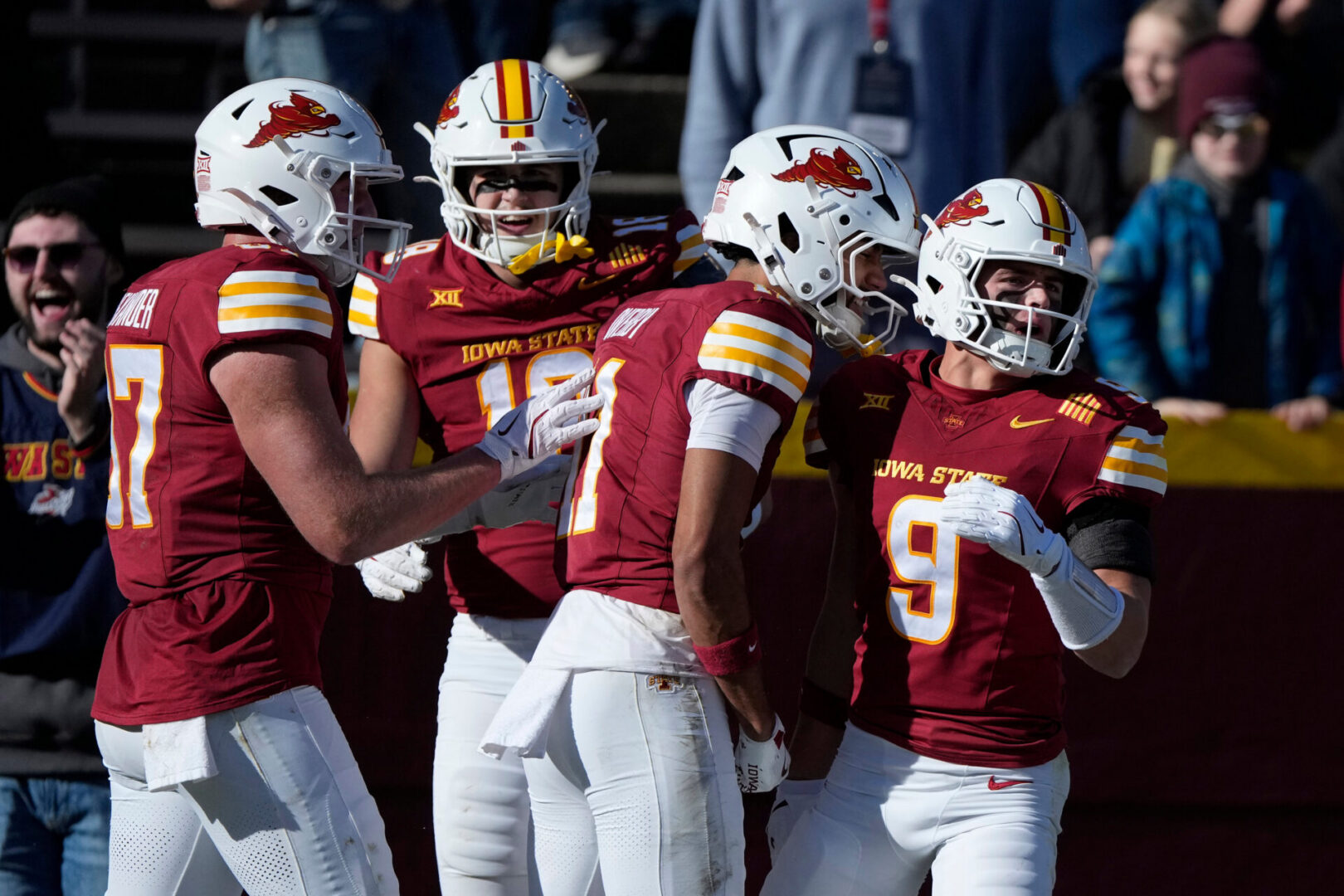
I watched every snap of all 12 of Iowa State’s games last season, charting the highs and lows of an 8-4 campaign that felt far more volatile than the final record suggested. From the opening month, when the Cyclones looked like a legitimate Big 12 contender, to the frustrating mid-season stretch where injuries and inconsistency killed momentum, the film told a story that statistics alone couldn’t.
Now, as Penn State welcomes a wave of former Iowa State coaches and players into Happy Valley, I went back through the tape with one question in mind: What exactly are the Nittany Lions getting?
Here are my eight biggest takeaways.
1. Rocco Becht’s Injury
For the first five games, quarterback Rocco Becht looked like one of the most dangerous quarterbacks in the Big 12. He was decisive in the pocket, aggressively attacked intermediate windows and, most importantly, was willing to run. Iowa State’s offense functioned best when defenses had to account for Becht as a dual-threat player.
Against South Dakota, he was nearly flawless, opening 14-for-14 passing for 212 yards and two touchdowns while layering throws beautifully between defenders. But injuries piled up. The film shows a noticeable shift in Becht’s mobility after the 5-0 start.
Early in the year, he extended plays naturally and made up for offensive line inconsistency. By November, those designed runs largely disappeared, and scramble opportunities became checkdowns or throwaways. He simply didn’t move with the same confidence.
The statistical decline matched the tape. His timing became inconsistent, his footwork less stable and his downfield aggression more selective. Iowa State’s offense suddenly looked compressed.
That mattered because so much of Mouser’s system depends on quarterback movement. The Cyclones love layered route concepts and late-developing crossing combinations, which require a quarterback who can buy extra time. Once Becht lost some mobility, pass rushers closed faster and the offense became more predictable.
To Becht’s credit, he never stopped competing, but the film strongly suggests he was playing hurt for a significant portion of the season, and Iowa State’s ceiling dropped because of it.
2. Injury Bug
Becht wasn’t the only example. Iowa State’s injury situation became borderline absurd by the second half of the season.
At one point against Colorado, the Cyclones were so depleted they used an offensive lineman as their kicker. That sequence perfectly captured what the year became: a team trying to survive week-to-week with duct tape and bubble gum.
The secondary was hit hardest; cornerback injuries devastated Iowa State’s coverage structure, forcing younger defensive backs into major roles before they were ready. Safety Jeremiah Cooper, now a Nittany Lion, was forced to transition to cornerback.
The communication breakdowns became increasingly obvious on film. Safeties were constantly rotating late to protect inexperienced corners, which opened voids in the middle of the field and allowed explosive plays.
What looked like a potential 10-win team in September was simply trying to make it to the finish line.
3. Clutch Gene
Even during Iowa State’s collapse, Becht authored several genuinely impressive late-game moments. That’s the trait that kept showing up on film: the moments never looked too big for him.
There were multiple third-and-long or fourth-down situations where he stood in against pressure and delivered accurate throws. In two-minute drills, he played with urgency without becoming reckless. And despite the injuries, he still found ways to create off-script plays late in games.
Penn State has struggled offensively in high-pressure situations over the years, which made Becht’s composure stand out even more while studying Iowa State’s tape. The last time the Nittany Lions had someone with that kind of late-game prowess was 2018 with Trace McSorley.
Against Iowa, Becht and tight end Gabe Burkle repeatedly came through late in key moments to secure a 16-13 rivalry win. Against Arkansas State, Becht got off to a slow start while missing Burkle to injury, but with Iowa State trailing 10-9 late in the second quarter, he engineered a 28-second touchdown drive before halftime filled with high-level throws under pressure.
Against Cincinnati, despite an injury scare, Becht led a clutch scoring drive before halftime and converted three fourth downs to wide receiver Chase Sowell late in the fourth quarter while trying to mount a comeback.
He nearly led a game-winning touchdown drive with under two minutes to play against Arizona State, but Sowell fell one yard short of the line to gain on fourth down, ending a promising drive. A week later, Becht and the Cyclones overcame a 17-6 fourth-quarter deficit to beat TCU.
Those plays explain why coaches love him. Becht may not have finished the season statistically dominant, but the tape shows a quarterback with toughness, leadership and situational poise. Teammates clearly rallied around him, and Iowa State’s offense maintained belief because of him even when the injuries mounted.
4. A Tale of Two Safeties
Of all the Iowa State players headed to Penn State, safety Marcus Neal Jr. impressed me the most on film. He was an underrated star for the Cyclones.
In the opener against Kansas State, Neal was everywhere, cleaning up quarterback runs, covering ground sideline-to-sideline and showing the versatility to play in the box or deep in coverage. He looked like the defense’s eraser all season.
What really jumped out was his tackling. Neal isn’t just a coverage safety; he’s physical downhill and dependable in open space. He consistently limited gains that could have become explosive plays.
He has All-American potential in the right system. If Penn State allows him to play aggressively, he could become one of the Big Ten’s best defensive backs.
The evaluation for Jamison Patton is much tougher. He had flashes, especially as a downhill run defender, but the explosive plays were a recurring issue. On tape, he too often took poor angles or arrived late rotating over the top. Several of Iowa State’s biggest defensive breakdowns involved Patton struggling in coverage or misreading route stems.
Patton actually played well early in the season. Against South Dakota, he finished with six tackles and an interception. But as the season progressed, his inconsistency became harder to ignore.
Colorado was particularly rough. Patton struggled with angles and allowed multiple explosive plays while trying to compensate for injuries around him. Some of that responsibility falls on the chaos around him. Injured cornerbacks forced safeties into impossible situations at times. But the inconsistency was real.
5. Drops
One of the quieter reasons Iowa State’s offense stalled late in the season was the inconsistency from the wide receiver room. The film showed many drive-killing drops, especially in high-leverage moments when Becht actually delivered catchable throws under pressure.
That issue became especially noticeable because Iowa State’s offense already operated with a thin margin for error once injuries piled up. The Cyclones relied heavily on timing routes, intermediate crossers and layered concepts that demanded precision from both the quarterback and his receivers. Often, the execution wasn’t there.
Transfers Brett Eskildsen and Chase Sowell both flashed legitimate talent on film, but the consistency never fully materialized. Eskildsen showed good body control and an ability to uncover against zone coverage, yet concentration drops repeatedly stalled possessions.
Sowell offered more explosiveness and became one of Becht’s favorite targets, especially against Cincinnati during Iowa State’s comeback attempt. But even he struggled at times finishing routine catches.
The frustrating part is that the separation was often there. Iowa State’s scheme generated opportunities. Mouser manufactured favorable matchups through motion and formations, and Becht was generally willing to trust his receivers in tight windows. But too many catchable balls hit the turf.
For Penn State fans hoping the room makes a significant jump after several down years, that may not be the case immediately.
6. Ebel Emerged Late
Linebacker Kooper Ebel may not have produced eye-popping statistics every week, but the tape showed a player whose impact steadily grew as the season progressed. After transferring from Iowa State to Penn State this offseason, he arrives as a far better player than most people nationally probably realize.
Part of the challenge evaluating Ebel is understanding the nature of Iowa State’s 3-3-5 defense under defensive coordinator Jon Heacock. The system simply didn’t allow linebackers to showcase their full talents.
On many snaps, the Cyclone linebackers lined up within three yards of the line of scrimmage and were asked to either attack downhill on run plays or drop into shallow underneath zones that rarely led to actual coverage opportunities. It’s a role built more around clogging the field than play-making.
Even within those constraints, Ebel’s growth became obvious late in the year. Over Iowa State’s final four games, he totaled 35 tackles — nearly half of his season total — and a forced fumble. His trigger against the run improved noticeably, and he became much more comfortable navigating traffic near the line of scrimmage.
He may not arrive at Penn State with massive tackle totals or national recognition, but the traits are there. In a more linebacker-friendly system that allows him to play freer and operate in space more often, Ebel could take a significant step forward.
7. Brahmer Delivered in Big Moments
Tight end Ben Brahmer’s season never became fully dominant because he spent portions of the year managing minor injuries, but the flashes on tape were impossible to miss.
When healthy, Brahmer looked like he could blossom into the next highly productive tight end to pass through Penn State.
What immediately jumps out is his catch radius, standing at 6-foot-7, and his body control. Iowa State trusted him constantly in contested situations, especially on intermediate throws over the middle and near the sideline. He repeatedly bailed out Rocco Becht on off-platform throws and difficult timing concepts.
More importantly, Brahmer consistently showed up in big moments. On third downs, in red-zone situations and during late-game drives, Becht looked for him repeatedly. Several of Iowa State’s most important offensive sequences involved Brahmer making difficult catches through contact or extending drives in traffic.
The highlight plays also stand out on film. Brahmer made multiple catches that required elite concentration and adjustment ability, including several grabs where he contorted his body midair or secured the ball through heavy contact. Those types of plays tend to translate regardless of system or conference.
Penn State has built a reputation for developing tight ends into major offensive weapons, and Brahmer looks capable of continuing that tradition. The combination of size, hands, toughness and situational reliability gives him a chance to become a major factor quickly in Happy Valley, assuming he continues to improve as a blocker.
8. Campbell’s Culture
There’s a reason Penn State invested heavily in former Iowa State coaches and players: Campbell built an extremely resilient football program.
The Cyclones were disciplined, tough and adaptable despite adversity. Iowa State’s coaching staff consistently found ways to maximize personnel, whether through creative pre-snap motion against Iowa, heavy tight end usage throughout the season or the introduction of the Alex Manske quarterback package as a runner against Cincinnati.
Mouser also deserves credit for his creativity and adaptability. Iowa State frequently used formations and motion to manufacture favorable matchups despite personnel limitations. The offense leaned heavily on tight ends, play action and layered route concepts throughout the season.
Broadcaster Gus Johnson shared a story about Mouser’s girlfriend giving him an ultimatum years ago after struggling with the move to Ames: “It’s Matt Campbell or me.” She’s now his ex-girlfriend. That loyalty explains a lot about Iowa State’s program.
The Cyclones weren’t perfect in 2025. They struggled against quarterback runs. The tackling deteriorated late. Defensive coordinator Jon Heacock’s unit became increasingly vulnerable once injuries mounted. But the effort never disappeared.
Penn State is inheriting players shaped by that environment. And after watching every snap of Iowa State’s season, I believe that matters more than anything else.